

You’ve probably been told that print marketing is dead. That if you can't slap a tracking pixel on a physical object, it doesn't belong in a modern growth strategy. We bought into that exact same lie for years. But completely dumping your offline strategy just because it feels hard to measure means you are leaving massive money on the table. You just need the right system to connect the ink on the paper to the data on your screen. Let's fix that.
1. Introduction: The Great Marketing Divide
We operate in two completely different realities right now. There is the physical, messy world where your actual customers live and breathe. And then there is the digital dashboard where we desperately try to make sense of what they are doing. Reconciling those two spaces has always been the most painful part of running a business.
1.1 The Classic Dilemma: The Ghost of Wasted Budgets
"Half the money I spend on advertising is wasted; the trouble is I don't know which half."
John Wanamaker dropped that line over a century ago. It stuck around because it perfectly captures that pit in your stomach right after you approve a massive campaign budget. You wire the funds. You push the message out into the wild.
And then you wait.
You just sit there hoping the phone rings. Hoping someone actually walks through the door. For decades, marketing was basically a high-stakes guessing game dressed up in a nice suit.
1.2. The Digital Illusion: Impressions vs. Reality
Then the internet showed up to save us all.
Digital platforms handed us these beautiful, glowing dashboards packed with data. Real-time clicks. Reach. Impressions. We thought Wanamaker's curse was finally broken.
But as the digital space matured, a weird thing happened. We realized those numbers often lie. Or at least, they aggressively stretch the truth. A platform brags that your ad hit 10,000 impressions. But if 9,000 of those were just people angrily swiping past your video on their way to a meme compilation while standing on a crowded subway, does that actually equal buying intent? No. We got completely drunk on the sheer volume of data. We started chasing cheap clicks and completely forgot about actual paying customers.
1.3 The Offline Black Hole: The Anxiety of Print
That digital dashboard addiction ripped the marketing world in half.
On one side, you have the hyper-measured digital ecosystem. On the other, the "offline black hole."
Think about the actual physical sensation of dropping cash on 5,000 heavy-stock, beautifully designed flyers. Or a billboard on the highway. Or a stack of thick restaurant menus. The second those materials leave the printer, they vanish off the grid. You hand a brochure to a prospect and immediately lose all visibility into what happens next. Did they read it on the train? Did it end up lining the bottom of a birdcage? Did they stick it to their fridge with a magnet?
It is a terrifying way to spend money. You have zero hard proof of return on investment. And because that blind spot is so massive, tons of businesses just gave up on the physical world entirely, writing it off as an outdated dinosaur.
1.4 The Modern Consumer Journey: Living in a Hybrid World
Here is the massive flaw in abandoning physical marketing: your buyers do not live trapped inside their computer screens.
The real consumer journey is messy. It is hybrid. A customer spots a physical poster at a coffee shop, files the brand name away in their head, and then Googles it from the couch three hours later. They grab a physical mailer, leave it sitting on the kitchen island for ten days, and eventually type the URL into their iPad.
People jump the fence between physical and digital all day long. Offline marketing absolutely works. The real failure is that businesses let themselves get tricked into thinking it can't be tracked. They started believing offline and online demand completely different measuring sticks.
1.5 The Core Objective: Merging the Worlds
What if you didn't have to choose?
You don't have to trade the tangible weight of a printed piece for the surgical tracking of a digital dashboard. At jmpy.me, we know the technology to crush this gap already exists. It is completely accessible right now. You can track a physical piece of paper with the exact same ruthless accuracy as a Facebook ad. You can see exactly when a prospect interacts with your brochure, what kind of phone they are holding, and if that real-world action actually turns into cash in the register.
Stop guessing which half of the budget is dead weight. You just have to wire the physical and the digital into a single dashboard.
2. The Tools of the Trade: Unifying the Physical and Digital
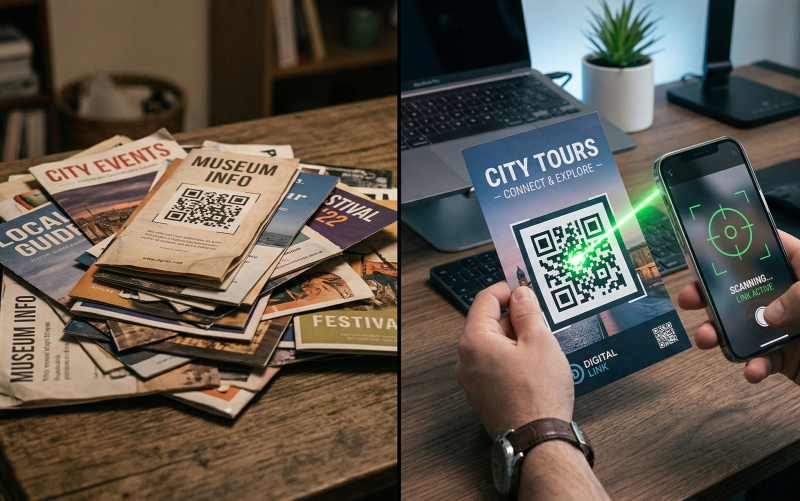
To build this bridge, you don’t need a massive enterprise IT budget or a team of Silicon Valley engineers. The architecture required to fuse your offline marketing with your digital analytics relies on tools you probably already know. The difference? You are going to stop using them passively and start weaponizing them for data collection.
We aren't creating new technology out of thin air. We are taking the foundational elements of the internet and rewiring them to extract every ounce of actionable intel. You already have access to the hardware. Now it’s time to learn how to actually use it. Let's break down the exact mechanisms that make this physical-to-digital tracking possible, starting with the most wildly underestimated asset in your toolkit.
2.1 Redefining the Short Link: Your Digital Tracking Engine
In the early days of the internet, short links were basically a cosmetic band-aid. You used them because social media platforms had massive character limits and dropping a gigantic, ugly string of text took up half your post.
That cosmetic function is dead. It is the absolute least interesting thing about them now.
A modern short link acts like an invisible tollbooth. When someone clicks it, before they ever hit your actual webpage, the link stops them for a microsecond. It grabs the exact time of the click. It logs their geographic location. It checks whether they are holding a phone or sitting at a desktop. It records exactly where they came from. You aren't just making a URL look pretty. You are hiding a silent analytics engine inside every single post.
2.2 The Evolution of the QR Code: The Physical Tracking Pixel
If the short link is your digital engine, the QR code is its physical twin.
Ten years ago, QR codes were an absolute joke. Think about the friction back then. You had to stand in the aisle of a store, realize you didn't have a scanner, download some clunky third-party app flooded with banner ads, and try to get the camera to focus. Almost nobody bothered.
Then Apple and Google baked the scanners right into the native camera apps. Pointing your phone at a square is just muscle memory now. But marketers are still treating them like dumb digital shortcuts. They aren't. When you generate a QR code with a real tracking engine, it becomes a physical tracking pixel. It takes a real-world, flesh-and-bone action—a guy standing on a wet sidewalk scanning a bus stop poster—and instantly turns it into cold, hard digital data.
2.3 The Hybrid Link: Bridging the Divide
Here is where most campaigns fall apart. You use one system for your paid social links and some random free website to generate your QR codes. The data lives in completely different universes.
The actual magic happens when you stop doing that and build a "Hybrid Link." At jmpy.me, instead of splintering your systems, you generate a single, unified tracking ID. That ID lives a double life. It exists as a clickable short link for your Instagram bio, and simultaneously as a scannable QR code slapped on your product packaging. Because the architecture is identical, the data flows back to the exact same place. You finally get to open one dashboard and watch your physical packaging go head-to-head with your digital ads on a level playing field.
2.4 Dynamic vs. Static Routing: Future-Proofing Your Print
This technical detail is the difference between a smart campaign and throwing a pallet of cash into an incinerator.
When you print a standard, static web address or a basic QR code on a batch of expensive brochures, that ink is permanent. If your marketing team changes the landing page URL next Tuesday, you are screwed. If the product sells out, or the 20% off promo expires, those heavy-stock brochures are completely useless. You get to haul a heavy box of useless paper to the dumpster and pay the print shop all over again.
We fix this through Dynamic Routing. The QR code on your flyer doesn't send the customer straight to the website. It sends them to the jmpy.me server first, which instantly bounces them to the final destination. You can log into your dashboard three months from now and redirect that physical poster to a totally different campaign. Without reprinting a single thing.
3. Turning Paper into Data: Tracking Offline Marketing
Digital marketing spoiled everyone. Run a Facebook ad, and you know exactly who clicked it, what device they used, and exactly how much that click cost you. Offline marketing? It’s historically been a multi-thousand-dollar black hole. You distribute 10,000 pieces of expensive print into the wild and just sit by the phone, praying for a localized spike in sales. When revenue goes up, you have absolutely zero idea which specific poster, flyer, or campaign actually did the heavy lifting.

That ends now. Print isn't dead—it's just been completely blind. By using jmpy.me as the bridge between physical ink and the digital world, you are injecting digital-grade analytics directly into the real world. You stop guessing and start measuring. Every scan is a captured data point, proving exactly what works and exposing what doesn't. Let’s break down exactly how to weaponize this tracking across your physical assets.
3.1. Direct Mail & Flyers: The Value Exchange
Let's look at the classic mailer. For decades, the entire strategy relied on a customer cutting out a paper coupon, stuffing it in their wallet, and remembering to actually bring it to the cash register three weeks later. It was clunky.
You fix that friction with a tracked QR code.
But you can't just slap a naked, contextless black-and-white square in the corner of your flyer and expect the internet to rain money on you. You need a "Value Exchange." Your copy has to command the scan by offering something they actually care about. Ditch the boring "Visit our website" and print "Scan to instantly unlock your secret 20% neighborhood discount code." The exact second they point their camera to get that code, your jmpy.me dashboard lights up. You instantly know the scan time, the device, and exactly which zip code is eating up your marketing budget versus which ones are ignoring you completely. You just turned a dead piece of paper into a live data feed.
3.2 Billboards & Outdoor Transit: Proving the ROI of Expensive Real Estate
Writing the check for a billboard is painful. The sales rep hands you a glossy sheet promising "estimated daily traffic" and "vehicle counts," which is really just an educated guess about how many cars drive past the sign. You are paying a premium for eyeballs. You have absolutely zero idea if anyone is actually taking action.
This is where integrating a massive, high-contrast QR code alongside a punchy short link changes the power dynamic.
When a guy waiting at a bus stop scans the code, that vague "impression" turns into a definitive, undeniable data point. If you buy ads at three different transit stations across the city and track each one with a unique jmpy.me code, the dashboard tells you the truth. It reveals exactly which neighborhood is actually engaging with your brand, giving you the hard evidence you need to mercilessly cut the underperforming locations before your contract renews.
3.3 Product Packaging & Inserts: The Digital Unboxing Experience
If you sell physical goods, that moment when a customer slices the tape and opens your box is the highest level of attention you will ever get from them. And what do most brands do? They toss in a flimsy, generic "Thank You" card that immediately slides straight into the kitchen trash can.
What a massive waste.
Put a tracked QR code right on the insert. Offer a 60-second setup video, instant warranty activation, or a heavy discount on their next refill. When they scan it, you bridge the gap. An anonymous offline retail buyer suddenly transforms into an active, trackable digital customer profile.
3.4 Business Cards & Networking: Measuring the Handshake
Trade shows are exhausting. You hand out fifty business cards, fly home, and just blindly hope someone remembers your face.
A modern business card shouldn't be a crowded mess of phone numbers and email addresses. It should be a gateway. Replace all that clutter with a single tracked QR code linking straight to your digital portfolio or a calendar booking page. If you generate one jmpy.me link for the cards you hand out at a casual local meetup and a completely different link for the massive national conference in Vegas, the data does the talking. Weeks later, you can open your dashboard and see exactly which expensive event actually generated real digital follow-ups.
3.5 In-Store Signage & Table Tents: Capturing Idle Time
Customers spend an absurd amount of time just waiting around. They sit at restaurant tables staring at the wall while waiting for a burger. They stand in line at the register.
That idle time is incredibly valuable real estate.
Drop tracked QR codes on your table tents or checkout counter signs. But again, respect the Value Exchange. "Leave us a Google Review to get a free dessert right now" is an irresistible hook. When a restaurant owner tracks these specific codes, they can actually look at the data and see which specific tables or sections of the dining room are generating the most scans.
3.6 Event Banners & Trade Booths: Catching the Overflow
Trade show floors are pure chaos. You are locked in a deep conversation with one decent prospect, while three absolute whales walk past your booth, glance at your banner, and vanish into the crowd because you were busy.
Print a massive, dynamic QR code straight onto your main event banner. It acts like a silent, tireless salesperson.
People walking by can scan it from ten feet away to download your digital brochure or enter a giveaway without ever needing to shake your hand. When the expo hall closes, you don't just count the sloppy handwritten email addresses on a physical clipboard. You check the dashboard to see how many silent scans that banner captured while your back was turned.
3.7 The Offline Challenge: Overcoming the Friction Factor
Tracking offline marketing is powerful. But we have to be brutally honest about human nature here.
Scanning a physical code takes work. It is objectively harder than clicking a link while slouched on a couch. The user has to physically pull their phone out of their pocket, unlock it, open the camera, aim it at a piece of paper, and tap the screen. That physical tax is the ultimate test of your marketing copy. If your scan numbers are garbage, it almost never means the jmpy.me tracking is broken. It means your offer isn't compelling enough to make someone reach into their pocket. The hybrid model forces you to ruthlessly optimize your real-world offers until they are too good to ignore.
4. Sharpening Your Digital Edge: Tracking Online Campaigns
Alright, let’s pivot away from paper and ink. You already know the internet is built for tracking. You don't have to fight the physical friction of convincing someone to open their camera—a tap is practically effortless. But that low friction creates a completely different problem: ruthless competition and consumer paranoia. The web is flooded with aggressive tracking, and modern users are highly skeptical. To win online, you need to capture every ounce of behavioral data without triggering your customer’s internal spam alarms. It’s about tracking everything while looking like you’re tracking nothing.
4.1 Beyond UTM Parameters: Building Digital Trust
Let's jump back over to the digital side.
For years, marketers have tracked clicks using UTM parameters. You know exactly what these are. They are those massive, ugly links that look like someone fell asleep on their keyboard. Something like yoursite.com/page?utm_source=facebook&utm_medium=ad&utm_campaign=spring_sale.
Marketers love them. Normal humans hate them. When a regular person sees a giant wall of code, their brain instantly screams "spam" or "I am being tracked." They hesitate. And hesitation kills clicks. By running that mess through jmpy.me, you hide the surveillance architecture behind a clean, simple URL. You still get the exact same granular data. But your customer walks through a front door that actually looks professional instead of like a phishing scam.
4.2 The "Link in Bio" Strategy: Your Traffic Command Center
Social media platforms like Instagram and TikTok are notoriously stingy with their real estate. They build walled gardens designed to keep people on their apps, which is why they give you exactly one clickable link in your profile. Just one.
If you are promoting a new YouTube video, a product launch, and a newsletter sign-up all in the same week, you are stuck playing musical chairs. You have to constantly swap that link out, hoping your followers happen to click it at the exact right moment before you change it again. It's an exhausting way to run a business.
Instead of constantly updating your profile, you drop a single, permanent jmpy.me link in your bio. Think of it as a digital switchboard. You never have to touch your social media profile again. Behind the scenes, you can instantly route that single link to your newest product, a flash sale, or a specific landing page, changing the destination daily or even hourly from your dashboard. More importantly, you stop relying on Instagram's vanity metrics and start seeing the raw data on who is actually clicking out of the app to view your offers, finally separating your real buyers from the passive scrollers.
4.3 Paid Ads (Facebook/Google): The Ultimate Lie-Detector Test
If you buy ads on social media or Google, you probably spend hours staring at their dashboards. Let me give you the hardest truth in the digital advertising industry.
The ad networks lie.
They love taking credit for everything. They use incredibly fuzzy attribution models to make their campaigns look wildly successful so you keep feeding their machine. Using our independent tracking links on your ads acts as a lie-detector test. Facebook might brag that it sent you 500 clicks. But if your jmpy.me dashboard only shows 150 actual human clicks—because we filter out the platform's own automated bots—you know you are getting played. Independent tracking keeps the tech giants honest. It protects your budget from fake numbers.
4.5 Email Marketing Segmentation: Silent Audience Insights
Email platforms are great at cheering when someone opens an email. They are terrible at telling you what happens next.
Say you send out a monthly newsletter featuring three different product lines. Don't just dump the readers onto your homepage. Drop three distinct, tracked short links. When you open your dashboard later, you aren't looking at generic traffic. You are watching your audience silently segment themselves. If 80% of your list clicks Product A, you suddenly have hard proof of what they want to buy. You stop guessing. You just build your entire next campaign around that specific craving.
4.6 SMS & Messaging Campaigns: Making Every Character Count
SMS marketing prints money, but it is expensive as hell.
You are fighting strict character limits. You absolutely cannot afford to paste a four-line URL into a text message. It looks desperate and eats up the space you literally paid for by the letter. A branded jmpy.me link keeps the text sharp. And since SMS is all about impulse, you hit send and watch the traffic spike in real-time. Test a text blast at 10:00 AM. Try another at 4:00 PM. The link data shows you exactly which crowd pulls their wallets out faster.
4.7 Influencer & Affiliate Tracking: Verifying the Hype
Paying influencers often feels like throwing darts in a dark room. An influencer flashes a screenshot of 50,000 followers.
But followers don't buy things.
Never pay someone just to shout your name on a video. Hand them a unique, tracked short link and tell them to put it in their bio. When the dust settles, you don't have to beg them for screenshots of their analytics. You just open your own dashboard. You see exactly how many actual humans clicked through. It puts the leverage entirely back in your hands, ensuring you only pay the partners who actually bring money through the door.
5. The Analytics "Aha!" Moment: Comparing Apples to Apples
You’ve rigged the system. Every flyer, billboard, and influencer bio is now a digital tripwire feeding you data. But raw data is completely useless if you have to spend three hours wrestling with spreadsheets just to figure out if you're actually making money. You don't need more scattered numbers or complex reports. You need a single, undeniable scoreboard.
5.1 The Unified Dashboard: The Power of Context
This is where the bleeding stops.
You’ve plastered tracked QR codes on your physical mailers and dropped tracked short links into your digital ads. Now you open the jmpy.me dashboard. The great marketing divide completely evaporates. On one screen, you are looking at the ROI of a heavy-stock mailer right next to a flashy Instagram reel. They aren't living in different universes anymore. You are judging both of them by the exact same metric: a hard, undeniable, intent-driven click. It is an "Aha!" moment that completely rewires how you look at your burn rate.
5.2 Scenario A (Print vs. Digital): The Ultimate Showdown
Let's run a real-world showdown. You burn $500 on local Facebook ads. You drop another $500 printing a stack of gorgeous flyers for a local event.
Before, you would just pray and guess which one actually drove foot traffic. Now, you just read the tape. If the dashboard shows Zuck's algorithm gave you 80 clicks, but those physical flyers generated 210 QR code scans, a massive, uncomfortable truth hits you. Your local market actually likes touching real paper. You finally have the ammunition to pull cash away from the social media slot machine and dump it into direct mail next month.
5.3 Scenario B (Location vs. Location): A/B Testing the Physical World
Digital marketers are obsessed with "A/B testing." They tweak a headline button color and wait for a winner.
With hybrid tracking, you drag A/B testing into the real world. Imagine you run a local service gig. You dump a stack of promotional postcards at a coffee shop on the north side of town. You leave another stack at a bakery down south. Each stack gets a slightly different jmpy.me QR code. A month later, you check the stats. 5 scans from the north side. 65 scans from the south side. You just uncovered a massive, hidden vein of demand. All because you put a smart square on a cheap piece of cardboard.
5.4 Time-Based Attribution: The Lifespan of an Ad
Digital ads have the lifespan of a fruit fly. The millisecond your credit card hits its limit on Google, your traffic flatlines. The ad is dead.
But physical marketing has a ridiculously long tail. A well-designed flyer or a branded sticker gets slapped on a community bulletin board. It gets stuck to a fridge with a magnet for six months. Your dashboard will actually show you this ghost traffic. You will see a slow, reliable trickle of scans coming from a batch of brochures you handed out in a parking lot half a year ago. It proves offline marketing often quietly outlives the chaotic, fleeting flash of digital spend.
5.5 Geographic Mapping: Revealing the Real World
When someone scans your code or clicks your link, the tracking engine quietly logs the region. Map this out and things get very clear, very fast. You might have bought a digital ad blasting a 50-mile radius, but the link data shows 90% of the actual human clicks are coming from two tiny zip codes. You immediately choke off the ad spend targeting the dead zones. Wasted budget disappears.
5.6 Device and OS Data: Knowing Your Audience’s Tech
Are they holding iPhones or Androids? Are they sitting at a desk on a PC, or walking down the street squinting at a screen?
The dashboard grabs that hardware data instantly. If you see that 85% of the people scanning your subway posters are holding Apple devices, you stop treating them like generic traffic. You optimize the landing page heavily for Safari. You put the Apple Pay button front and center. You build a frictionless checkout built exactly for the glass they are holding.
6. Adding the "Dark Social" Layer (Advanced Tracking)
When that URL drops into a private group chat, traditional analytics go completely blind. Marketers call this "Dark Social" like it’s some unavoidable black hole. It’s not. It is the most valuable word-of-mouth traffic on the internet, and right now, you are getting absolutely zero credit for it. Instead of accepting the blackout, here is how you keep the lights on and track the money when your links go underground.
6.1 What Happens After the Scan?
So we bridged the gap. We know they scanned the physical flyer. But buyers rarely stop there.
Usually, a guy scans a flyer, checks out the pricing, and thinks, "My co-founder needs to see this." He copies the URL from his mobile browser. He dumps it into a private WhatsApp group chat. In the old world of Google Analytics, you lose the scent right there. The trail goes completely cold.
6.2 Tracking the Offline-to-WhatsApp Pipeline
This is where advanced tracking feels like a superpower. Because you used a smart jmpy.me link as the destination for that QR code, the link keeps working long after the first scan.
Like we talked about in our "Dark Social" guide, when that guy pastes your link into a private WhatsApp chat, the app sends a silent bot to fetch the link preview. Our system catches that bot. Suddenly, you are watching a crazy chain reaction. You track the physical scan on the street. Ten minutes later, you track the "Share" happening inside a locked messaging app. You are watching a real-world piece of paper mutate into a private, digital, word-of-mouth referral.
6.3 Measuring True Virality: The Holy Grail of Hybrid Marketing
Combine the physical scan data with private share tracking, and you hit the holy grail: offline-to-online virality.
Picture handing out 100 die-cut stickers with a tracked QR code at a massive industry meetup. The dashboard says they got scanned 45 times. Not bad. But then the share tracking lights up like a Christmas tree. That specific link inside the QR code gets shared 300 times on WhatsApp and Telegram over the weekend. You didn't just buy 45 clicks with a $10 sticker budget. You bought the ignition switch to a viral loop. Once you can actually measure that kind of fire, you can start engineering it on purpose.
7. Budget Optimization: Making the Financial Call
You have the data. You have the context. Now you have to actually do something with it. Tracking scans and clicks is just digital theater if it doesn't fundamentally change how you spend your money. The dashboard isn't there just to make you feel smart—it is a financial scalpel designed to cut the fat out of your marketing budget. Here is how you use those numbers to ruthlessly kill what isn't working and double down on what is.
7.1 Calculating True Cost-Per-Acquisition (CPA)
Data is absolute garbage if it doesn't actually stop you from setting your cash on fire.
Once you plug your offline and online campaigns into the jmpy.me dashboard, you have to do some basic math. Take the raw cost of a campaign. Let's say you dropped $300 on a batch of glossy direct mailers. Check the dashboard. How many times did that specific QR code actually get scanned by a human being? Let's say you pulled in 150 scans. Divide the cash by the action. Your physical Cost-Per-Click is two bucks.
Now go look at your Google Ads account. If your digital CPC is sitting at $3.50, you just found a massive financial exploit. You are literally paying less for a highly intentional, physical real-world scan than you are for a fleeting, accidental thumb slip on a digital ad.
7.2 Identifying the "Money Pits"
We all have that one marketing expense we keep paying just out of pure, lazy habit. A local magazine ad. A golf course sponsorship. You write the check every year because you are terrified that if you stop, the phone will stop ringing.
Stop operating on fear. Slap a unique tracked code on that magazine ad. When you check the dashboard 30 days later and stare at a grand total of zero scans, the debate is over. The emotional attachment dies instantly. You just found a money pit. Cut the check immediately and funnel that cash into a channel that actually spits out revenue.
7.3 Scaling the Winners in Real-Time
Locking your marketing budget in a spreadsheet once a year is a great way to go out of business. It needs to breathe.
If you hit the middle of the month and your jmpy.me dashboard shows your Facebook ads are absolutely bleeding cash with zero return, but the QR codes on your retail window posters are getting hammered with traffic, you move. Fast. You pause the Zuckerberg slot machine. You take that saved budget, rush order more posters, and plaster them everywhere. You follow the heat in real-time.
7.4 Negotiating Better Rates with Hard Data
The guys selling billboard space and radio spots are masters at selling you fog. They throw around terms like "estimated daily impressions" and "broad demographic reach" to justify their eye-watering invoices.
When you control the tracking, you hold the gun. If that transit vendor tries to jack up your renewal rate by 20%, you don't argue with them. You just slide your dashboard data across the table proving their expensive bus stop poster only drove 12 website visits in six months. You aren't a passive buyer anymore. You are a sniper holding hard data.
7.5 A/B Testing the Real World
Digital teams love their A/B tests. They will argue for hours over whether a red or a blue button gets more clicks. But with hybrid tracking, we can finally drag that ruthless scientific method out onto the sidewalk.
Print two different stacks of flyers. Stack A pushes a "Free Trial." Stack B screams "Save 20% Today." Give each stack its own unique jmpy.me code, and drop them in the exact same neighborhood. The dashboard doesn't care about your feelings. It will declare a cold, hard winner. You never have to sit in a room and guess what copy works for your local market ever again.
7.8 The Agile Budgeting Mindset
This whole thing forces a brutal mindset shift.
You stop treating marketing like you are spinning a roulette wheel. It becomes a strict investment portfolio. You run cheap, tiny experiments across physical paper and digital pixels. You watch the unified dashboard like a hawk. You slaughter the losers without a single second of hesitation. And you aggressively dump money into the winners.
8. Implementation Guide & Critical Best Practices
The theory is bulletproof, but execution is where most marketers trip over their own shoelaces. If you just start blindly generating links and slapping QR codes on random surfaces without a system, you aren't building a tracking engine—you are just creating more noise. To actually turn jmpy.me into a precision weapon, you have to follow a few non-negotiable operational rules.
8.1 The Golden Rule of Tracking: Never Reuse a Tracking ID
Let's get the most important rule out of the way right now. Never, ever use the same tracked link or QR code for two different things.
If you drop the exact same jmpy.me QR code on your business card, the sticker on your storefront window, and a batch of heavy-stock direct mailers, you just ruined your own data. You will see scans happening. But you won't have a clue where they are coming from. It becomes a tangled, useless mess. Every single piece of cardboard, every digital ad, and every physical location needs its own dedicated tracking ID. Period.
8.2 Naming Conventions: Keeping Your Dashboard Clean
If you follow that golden rule, you are going to generate dozens of links fast. If you get lazy and leave them named "Link 1," "Link 2," and "Link 3," you will open your dashboard in three weeks and stare at a wall of meaningless garbage.
Build a strict naming convention today. We recommend something like [Year/Month] - [Medium] - [Location] - [Offer]. For example: 2024_Oct - PrintFlyer - Downtown - 10PercentOff. When you open jmpy.me over your morning coffee, you instantly know exactly what campaign is printing money without having to decipher a puzzle.
8.3 Design Integration: Don't Just Slap It On
I see this nightmare all the time. A brand pays a designer thousands of dollars for a gorgeous physical poster. Then, right before it goes to the printer, they slap an ugly, harsh black-and-white QR code in the bottom corner like a dirty afterthought.
People ignore it. It looks like a mistake.
Integrate the code into the art. Use your brand colors. Soften the edges. Give it some breathing room. If you crowd the code with heavy text or graphics, a smartphone camera will struggle to focus on it. That creates friction. Friction kills your conversion rate.
8.4 Clear Call-to-Actions (CTAs): Tell Them Why
A naked square floating on a page is invisible.
Humans don't scan things just because the technology exists. They scan them because they are selfish and want what is on the other side. You have to pair your physical codes with aggressive, benefit-driven copy. "Scan Here" is weak and boring. "Scan to see if we service your zip code." "Scan to jump the VIP waiting list." Give their brain a specific target.
8.5 Mobile Optimization is Mandatory
Think about the actual physical reality of a QR code scan. Literally 100% of the people who interact with your printed marketing are staring at a piece of glass in their hand.
If they scan your beautiful physical poster and it routes them to a massive desktop website that takes twelve seconds to load and forces them to pinch-and-zoom just to read the headline, the interaction is dead. The jmpy.me tracking will show a scan, but your bank account will show nothing. Your destination page has to be lightning-fast and built specifically for a vertical screen.
8.6 The Pre-Print Sandbox Test: Avoiding the Expensive Mistake
Do not send an order for 10,000 heavy-stock brochures to a commercial printer without testing the tracking.
Print a single, cheap copy on your home inkjet printer. Scan it with an iPhone. Scan it with a Samsung. Make absolutely sure it routes to the right page. Then log into your jmpy.me dashboard and verify those two test scans actually registered. A five-minute test sitting at your desk saves you from the absolute horror of paying to print and distribute thousands of dead links into the real world.
9. The Future of Hybrid Marketing
You’ve built the tracking engine. You know how to measure physical ink with the exact same ruthless precision as a digital ad. But this isn’t just a tactical hack to save a few bucks on a bad flyer campaign. This is a fundamental shift in how business operates. The separation between the physical world and the internet is collapsing, and the businesses that don't recognize the shift are going to be left behind.
9.1 The Blurring Lines Between Digital and Traditional
For the last ten years, agencies loved building walls. You had the "Traditional Marketers" buying heavy-stock paper and expensive highway billboards, sitting completely isolated from the "Digital Marketers" obsessing over social media algorithms and SEO.
That wall is completely dead.
The modern marketer has to be a hybrid. When a piece of physical mail actually triggers the start of a digital sales funnel, those two massive disciplines violently crash into each other. The brands that actually survive the next five years won't be sitting in a conference room arguing over whether to spend their cash on offline or online campaigns. They will treat the whole thing as one single, ruthless ecosystem.
9.2 The Shift to First-Party Data
Privacy laws are getting aggressive. Apple and Google are systematically hunting down and slaughtering third-party cookies.
Relying on Facebook to track your buyers for you is a massive liability now. The ad networks are flying blind, which means your customer acquisition costs are going to skyrocket unless you adapt. This makes "First-Party Data"—the raw, unfiltered information you actually own—the single most valuable asset sitting on your balance sheet. By forcing real-world and digital traffic through your own jmpy.me tracked short links and dynamic QR codes, you stop renting your analytics from the tech giants. You own the data. You build your own private database of actual customer intent.
9.3 Democratized Enterprise Analytics
A decade ago, trying to track a physical billboard scan straight into a digital sales dashboard was an absolute nightmare. You needed a team of expensive developers, custom server architecture, and a bloated enterprise budget just to make the tech talk to each other.
Not anymore.
The heavy lifting is done. At jmpy.me, we took that exact same hyper-sophisticated, enterprise-level tracking architecture and handed it straight to bootstrapped founders, local service shops, and independent creators. The technology to dominate this hybrid game is sitting right in front of you. You just have to actually turn it on.
10. So, What Exactly Should You Do Now?
You have the playbook. You know the mechanics. Now it’s time to actually pull the trigger. Knowing how the engine works doesn't put money in your bank account—execution does. It’s time to kill the campaigns that are bleeding you dry and scale the ones that actually convert. No more blind spends. No more hoping for the best.
10.1 From Guessing to Knowing
We started this entire playbook talking about that sick feeling in your stomach. That underlying anxiety of wiring a massive campaign budget and just praying the money doesn't vanish into the void.
When you finally wire your offline and online tracking together, that knot goes away.
You stop guessing if a batch of heavy-stock mailers actually drove foot traffic. You stop blindly trusting an ad network's inflated dashboard. You move from a state of pure, terrifying guesswork to cold, hard, data-driven knowing.
10.2 Taking Total Control of Your Budget
Analytics are not just pretty charts you look at once a month to feel good about your brand. They are a financial weapon.
Once you unify the tracking for the paper on the street and the pixels on the screen, you get absolute clarity. But just having the data isn't enough. You have to actually pull the trigger and do something with it. You have to cut the campaigns that are bleeding your bank account dry and dump that cash into the channels that are actually driving real humans to pull out their wallets.
10.3 The Action Plan: Your Next 30 Days
Stop reading about marketing theory and actually start fixing your tracking. Here is exactly what a human being running a real business needs to do this week.
Audit the Blind Spots: Pull up your marketing budget right now. Look hard at it. Circle the exact line items where you are buying physical cardboard, posters, or direct mail and just hoping it pays off. Circle the digital ads running without an independent tracking link. Those are your targets.
Run the Hybrid Test: Pick just one physical asset. A single flyer, a package insert, or a business card.
Generate the Ammo: Go into jmpy.me and create a secure short link for your digital campaign. Our system will instantly hand you a dynamic QR code built specifically for your physical print. You don't have to ask for it. You don't have to go find a clunky secondary tool. It is just there.
Watch Them Fight: Push the campaign live. While the short link and the QR code share the exact same destination, our dashboard tracks the digital clicks and the physical scans completely separately. Watch the command center. Let your physical posters go to war against your digital ads in real-time.
Slaughter the Losers: At the end of the month, do the math. If the physical print drove cheaper conversions, pause your digital ads. If the digital ads won, fire your commercial printer. No emotion. Just math.
Ready to Turn the Lights On?
Bridging this gap shouldn't require a degree in data science.
That exact frustration is why we built the platform. You shouldn't have to stitch together three different software subscriptions just to know if a flyer actually worked. You get one clean command center.
Stop treating your print budget like a massive guessing game. Start tracking your offline and online campaigns in one place with jmpy.me today.
Share this insight
Help others grow
0 Shares